
All Categories
- All Categories
- AQUARIUM INVERTEBRATES
- Anemone
- Clam
- Crab
- Cucumber
- Nudibranch
- OCTOPUS / CUTTERFISH
- SEAHORSE / PIPEFISH
- Shrimp
- Slug
- Snail
- Star Fish
- Tube Worm
- Urchin
- AQUARIUM TANK
- BRAND
- ALKATRONIC
- API
- AQUA IIIUMINATION
- AQUA PHARM
- AQUA VITRO
- AQUA ZONIC
- AQUAFOREST
- AQUARIUM MUNSTER
- AQUARIUM SYSTEMS
- AQUATIC FARMER CORAL CUTTER
- AQUAWIZ
- ARTREEFROCKS
- ASTRO
- ATI
- ATMAN
- AUTO AQUA
- BCUK
- BLUE LIFE
- BLUE SHARK
- BOYD
- BOYU
- BRIGHTWELL AQUATICS
- BUBBLE MAGUS
- CAPERPLUS
- CARIBSEA
- COLOMBO
- CORAL BOX
- CORAL DIP
- CYCLOP-EEZE
- D-D Aquarium Solution
- DAZS
- DEEBOW
- DELTEC
- DOPHIN
- DVH
- EASY REEFS
- ECO TECH MARINE
- EHEIM
- ESHOPPS
- FAUNA MARIN
- FLIPPER
- FLUVAL
- GROTECH
- GRYPHON
- HAGEN
- HAILEA
- HANNA INSTRUMENTS
- HELIOS
- HIKARI
- ILLUMAGIC
- ISTA
- JBL
- JEBAO
- Joesjuice
- KAMOER
- KELORAY
- Kessil
- KH Guardian
- KORALLEN ZUCHT
- LRS Foods
- MagFloat
- Mantis
- Marine Lab
- MARINE PURE
- MAXSPECT
- MICROBE LIFT
- MILWAUKEE
- Mountain Tree
- NEARTH
- NEPTUNE SYSTEMS
- NEW LIFE SPECTRUM
- Nice
- Nirox
- NUBIOS
- NUTRAFIN
- NYOS
- OCEAN FREE
- OCEAN NUTRITION
- OCEAN WONDERS
- Odyssea
- ORCA LABORATORIES
- Orphek
- POLYP LAB
- PRODIBIO
- RED SEA
- RED STARFISH
- REEF NUTRITION
- REEF OCTOPUS
- RESUN
- RIO
- ROYAL NATURE
- SALIFERT
- SANKING
- SEACHEM
- SEIO
- SELCON
- SENEYE
- SERA
- SHANDA
- SKIMZ
- SUN SUN
- TECO
- TICA
- TROPIC MARIN
- TUNZE
- TWO LITTLE FISHIES
- ULTRA LIFE
- USA RODI FILTER
- VAST OCEAN
- VIBRANT
- VITALIS
- WAVE POINT
- Wavereef
- WEIPRO
- ZETLIGHT
- ZOOX BIOMEDIA
- CATEGORIES
- ACCESSORIES
- AQUARIUM TANK PACKAGE
- BACTERIA
- BIO MEDIA
- CHILLER/HEATER
- CLEANING TOOLS
- CORAL FOOD
- DECORATION
- DOSING PUMP
- FISH FOOD / FEEDER
- FISH NET
- FRAGGING SUPPLIES / GLUE
- HYDROMETER / REFRACTOMETER
- LIGHTING
- MEDIA
- MEDICAL
- OTHER
- PROTEIN SKIMMER
- Quarantine Box / Isolation Box
- RETURN PUMP / PUMP
- Ro/Di Filter
- ROCK/SAND
- SALT
- SUPPLEMENT / TRACE ELEMENT
- TESTKIT / CONTRROLLER / REAGENT
- THEMOMETER
- WAVE MAKER / POWER HEAD
- CORAL
- FROZEN
- LIVE FISH
- ANGEL FISH
- ANTHIAS FISH
- BAT FISH
- BLENNY / GOBY
- BUTTERFLY FISH
- CARDINAL FISH
- CLOWN FISH
- DAMSEL FISH
- DOTTY BACK FISH
- EEL FISH
- FOX FACE / RABBIT
- LION FISH
- OTHER FISH
- PUFFER FISH
- SWEETLIPS / GROUPER
- TANG FISH / SURGEON FISH
- TRIGGER FISH
- WRASSE FISH

Tropic Marin K+ Test Professional for high precision determination of the potassium concentration in saltwater. Potassium is a vitally important macro-nutrient for all living beings. In natural ocean water, this alkali metal is present in an average concentration of 408 mg/l. In a saltwater aquarium, the potassium concentration is usually kept stable by regularly changing the water. Nevertheless, a lack of potassium can occur in individual aquariums tanks due to the use of zeolites and other adsorbents. One sign of a possible lack of potassium is clear discolouration of corals and retraction of polyps. The potassium level in a saltwater aquarium should be checked regularly to ensure that the level is between 380 and 420 mg/l.
With the high resolution titration test Tropic Marin Potassium Test Professional the potassium concentrations can be determined reliably with a resolution of 5 mg/l.
Tropic Marin K+ Test Professional
+ measurement range: 300 – 500 mg/l (ppm)
+ accuracy: 5 mg/l
+ for determining the K concentration in saltwater aquaria
+ sufficient for approximately 50 applications
+ incl. potassium standard to check function and shelf life of the test reagents
+ reagent as refill pack separately available
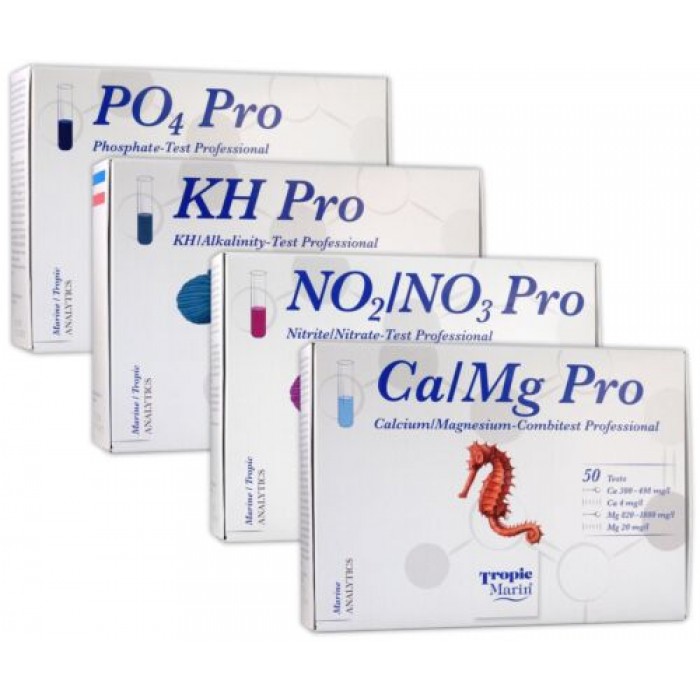
The carbonate hardness (KH) or alkalinity of a water sample characterises the buffering capacity, i.e. the ability to maintain the pH value of the water. There are many terms in water chemistry to describe the buffering capacity with varying definitions. The term “carbonate hardness” is customary in fishkeeping; however, it is the alkalinity which is measured. In this test, both terms are used synonymously. The reading for alkalinity is usually given in degrees of German hardness (°dH).
The alkalinity should be tested in all aquariums with great regularity. If the alkalinity in the aquarium is too low, the pH value can sink (sudden drop in acidity) to a level which is life-threatening for many fish and invertebrates. In reef aquariums, an adequate alkalinity level is essential for strong coral growth. On the other hand, an overly high alkalinity in saltwater tanks can lead to calcium carbonate precipitates and also have a negative impact on coral growth. The alkalinity in saltwater aquariums should range from 6 to 9 °dH. The alkalinity in freshwater aquariums should not fall below 3 °dH.
The Tropic Marin® KH/Alkalinity-Test Professional is a high resolution test kit for the determination of the alkalinity with a resolution of up to 0.1 °dH per titration; including a conversion table to other units. Easily recognizable colour change from turquoise blue to pink.
Along with sodium, potassium, chloride and sulphate, calcium (Ca2+) and magnesium (Mg2+) are two key components of natural seawater. Magnesium and, above all, calcium are important growth factors for organisms which form calcareous skeletons, such as hard coral and coralline algae – both elements form the basic substance of the calcareous skeleton. Furthermore, magnesium and calcium are involved in numerous biochemical processes. In saltwater applications, the reduction in the magnesium or calcium concentration caused partly by cellular metabolism and partly by skeleton formation means it is necessary to test the concentration levels on a regular basis and, if required, add more of one or both ions. This makes it possible to guarantee optimum, near-natural living conditions for all organisms and to prevent long-term damage.
In natural seawater, the calcium concentration is 400-410 mg/l (ppm) and the magnesium concentration is 1280-1320 mg/l (ppm). They also have a fixed ratio of 1:3.25 to one another. Due to the chemical and biochemical interdependencies between calcium and magnesium, you should also aim to achieve this concentration ratio in saltwater tanks.
With the high resolution titration test Tropic Marin® Calcium/Magnesium Combitest Professional the calcium and magnesium concentrations can be determined reliably and separately with a resolution of 4 mg/l Ca and 20 mg/l Mg.
Phosphate - what is that?
Phosphate belongs together with nitrate to the macro nutrients.
Where does the phosphate in my aquarium come from?
Phosphates are usually introduced by food. However, dying organisms, contaminated water, sand or rocks can also lead to an increase in phosphate-levels. In addition, calcium reactors, which are operated with crushed coral, are a source of phosphate.
Why is the determination of phosphate important?
High phosphate concentrations can lead to unwanted algae growth. In addition, there are negative effects on the growth and coloration of corals. Therefore you have to ensure that the phosphate concentration in your reef aquarium is in a range of 0.01 - 0.05 mg/l.
Despite the negative aspects listed above, you should not forget that phosphate is a vital nutrient. A long lasting lack of phosphate will inevitably lead to the death of your corals.
Why Professional? Is a simple test not enough?
In seawater, phosphate is usually found in very low concentrations. In addition, the difference between a value of 0.02 mg/l and 0.07 mg/l phosphate is already enormous for most corals. To record these low levels correctly, a test with a very high accuracy is necessary. Furthermore the Tropic Marin Phosphate Test Professional contains a standard which allows you to check your measured values and correct them with a correction factor if necessary.
Tropic Marin NO2/NO3 Test Professional for high precision determination of the nitrite and nitrate concentration in freshwater and seawater. Nitrate ions (NO3–) are formed from ammonium (NH4+) as the end product of the nitrification process. Nitrite (NO2–), which is highly toxic to freshwater species in particular, is produced in the first stage of the bacterial process. If the nitrification process works, nitrite is converted to the comparatively non-toxic nitrate in the second stage. Increased levels of nitrite above 0.05 mg/l (ppm) are usually found in tanks that are in their maturation phase or in tanks with nitrate filters.
Nitrate affects the quality of the water in the aquarium: Higher concentrations of nitrate in saltwater aquariums will end up inhibiting the growth of delicate coral. An algal bloom is often the result of a high nitrate level in an aquarium. Some reef aquariums have ultra-low nutrient conditions – nitrate shortages can occur in cases such as these. Therefore, the nitrate concentration in the aquarium water should be tested regularly. It is advisable to keep the nitrate concentration in freshwater aquariums below 50 mg/l (ppm), whereas the concentration should not exceed 20 mg/l (ppm) in saltwater applications. When nurturing hard coral, the aim is to keep the nitrate concentration below 10 mg/l (ppm). Lower limits for nitrate depend on the general conditions in the aquarium.
With the high resolution Tropic Marin Nitrite/Nitrate-Test Professional the nitrite and nitrate concentrations can be determined with a particularly high accuracy in the low concentration range between 0 and 1 ppm for nitrite and between 0 – 20 ppm for nitrate.
Tropic Marin NO2/NO3 Test Professional
+ measurement range: NO2 0 – 1,0 mg/l (ppm)
+ measurement range: NO3 0 – 20 mg/l (ppm)
+ accuracy: NO2 0.002 mg/l
+ accuracy: NO3 0.05 mg/l
+ for determining the nitrite/nitrate concentration in aquaria
+ incl. comparator and standard to check function and shelf life of the test reagents
+ sufficient for approximately 50 applications
+ reagent as refill pack separately available
